
Product goals misalignment
A case study about misalignment of product goals with lessons learned so you don't have to make these mistakes.

About 9 months ago I changed positions within my organization. Mid quarter I moved from the B2C department to demand generation. I was given a growth PM position which was a nice opportunity to grow (no pun intended). I am not sure I really knew at the time what “growth PM” meant, and I'm not sure anyone really did, but it was a trendy buzz word and I decided the job description sounds interesting. We will figure it out.
For those who have never heard of the ‘growth PM’ or think of it only as lead generation, this is how chatGPT (for better or worse) defines it:
“A growth product manager is responsible for identifying and implementing strategies to increase the user base, revenue, and profitability of a product. This may include conducting A/B tests to determine the effectiveness of various growth tactics. They work with cross-functional teams and continuously optimize their strategies to achieve the desired results.”
The company I work for is a SAAS company and mainly targets businesses. When I made the move, I researched my area of ownership. I looked at our flows, at our competitions, at others that are not competition but were relevant. You get the idea, I took some time to understand the space, look at the data and make my decision on where the gaps were before I spoke to anyone. I aligned with my boss for the high level goals and I sat down to set KPIs (high level ones.) I set a rough plan of action to reach those goals. Nothing concrete yet.
One of my areas of ownership was (and still is) the registration of users. One of the goals I had was to increase the conversion on the registration page. Seemed like a straightforward north star. I aligned on it with my managers and defined it as the percentage of users that register out of those that land to the page. Great! We currently stood at 18% conversion on the page. Based on my research and data analysis I had a few ideas for tests I wanted to try.
As a growth PM I run a lot of experiments. And I mean A LOT. At any given time I have about 2-3 experiments running and 1-2 waiting to start. To tackle the registration page goal, I sat down with the UX team and we brainstormed and worked on it. I understood from the data that the vast majority of our users prefer to log in with social login (sign in with google) and decided to move that up above the business mail registration area to put more focus on it. We also did some other things, but that was a main change.
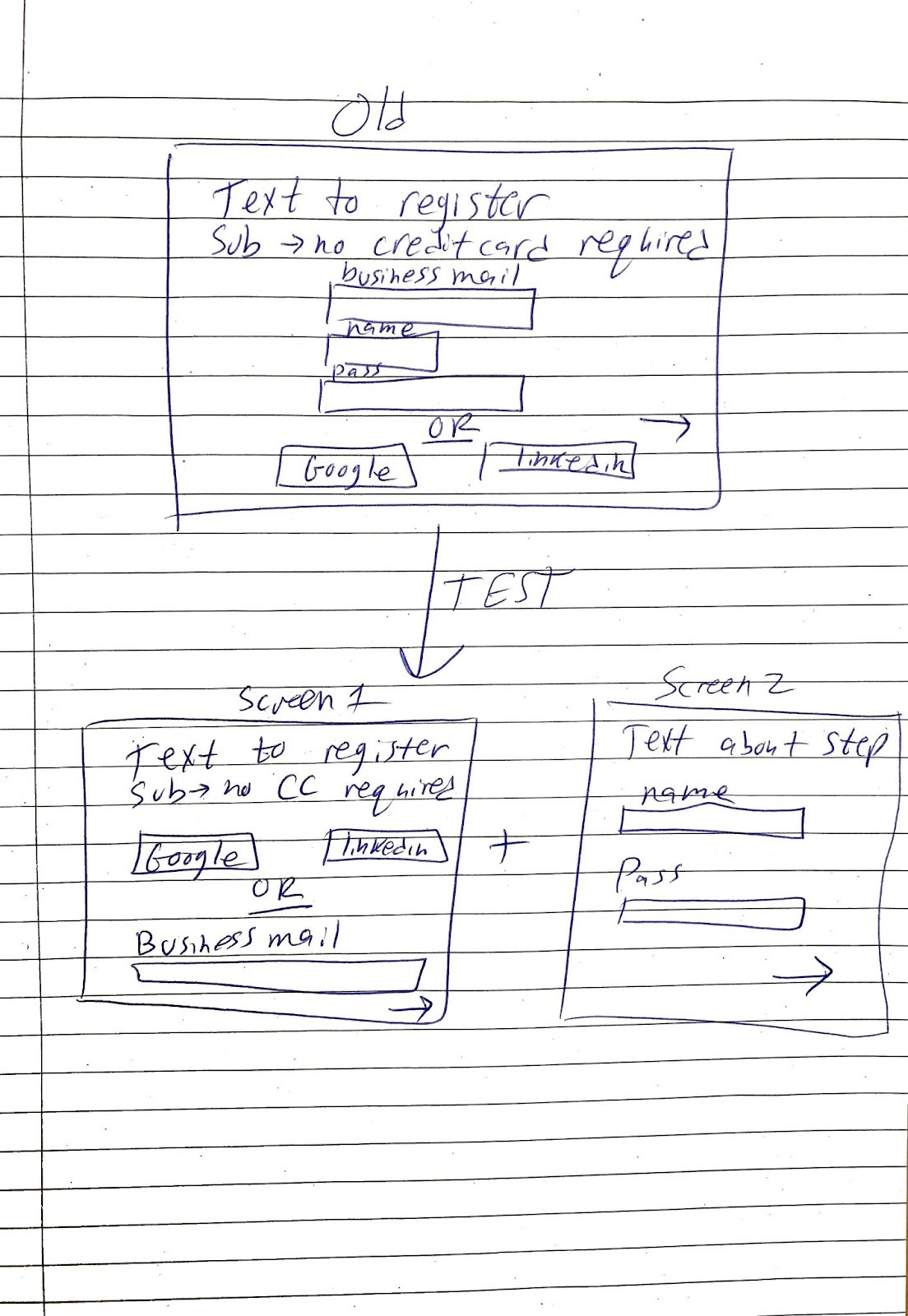
I ran the test, analyzed the results and BOOM 💥, 11% increase in conversion! [Mic drop 🎤]. There was no strong impact on meetings and revenue, however they did go down a bit. I shared the statistics and insights with the team and all the stakeholders by mail. When I broke down the conversion increase I saw that we had a significant drop in business mail registrations and an even more significant increase of social registration. Of course that makes sense, it is what we aimed for with the test, to increase the social registrations by making it easier for the users to do so.
It turns out the goal the executives had in mind was to increase conversion for business mail registrations. It is only one or two words off, but that makes a huge difference between a successful experiment and a failure.
Wait, how did this happen? Did I not ask the right questions? I don’t think that was the case but I can’t say that for sure. When I discussed this with my manager he said he doesn’t see this as a failure (which is nice of him) as it is what we aligned on.
I think my biggest miss here was not aligning with a wider circle of stakeholders about the goals and KPI table I created when I started the position.
What did I take from this and hope you do too?
Verify your goals and KPIs also with C-levels. If you can’t directly, try to make sure it was done by your manager/VP etc.
Ask yourself if the north star KPI fits with the grand scheme of business needs.
Before starting a test, share those goals/KPIS/counter metrics not only with the “closest” stakeholders but also with a wider bunch (not just the C-levels).